What Is Steganography and Why It Matters
Steganography — derived from the Greek words steganos (covered) and graphein (writing) — is the art and science of concealing information within another medium in such a way that the very existence of the hidden message remains undetectable. Unlike cryptography, which scrambles a message into an obviously encrypted form that signals secrecy to any observer, steganography embeds data invisibly into a carrier file — an image, an audio track, or a video — without producing any visible or audible artifacts that would betray the presence of hidden content.
In the digital domain, image steganography has emerged as one of the most practical and accessible forms of covert data embedding. Digital images are everywhere: they are shared on social media billions of times per day, stored in cloud galleries, embedded in web pages, distributed in messaging apps, and archived in enterprise content management systems. An image carrying a steganographic payload looks indistinguishable from a normal image — it can be posted publicly, sent through email, or uploaded to a CDN without triggering any suspicion or automated content scanning. The hidden message simply rides along inside the pixel data, invisible to both human eyes and standard file inspection tools.
This property makes steganography uniquely valuable for several critical applications: invisible copyright watermarking for photographers and digital artists who need to prove ownership without degrading their work with visible logos; covert communication for journalists, activists, and security professionals operating in environments where encrypted channels are blocked or monitored; supply chain verification where provenance data must travel with product images through multiple untrusted intermediaries; and personal privacy protection where sensitive information needs to be stored or transmitted without drawing attention. StegTool was built specifically to democratize access to these capabilities by delivering a production-grade steganography engine that requires no software installation, no command-line expertise, and no server infrastructure — just a modern web browser and the images you want to protect.
The StegTool Technical Architecture
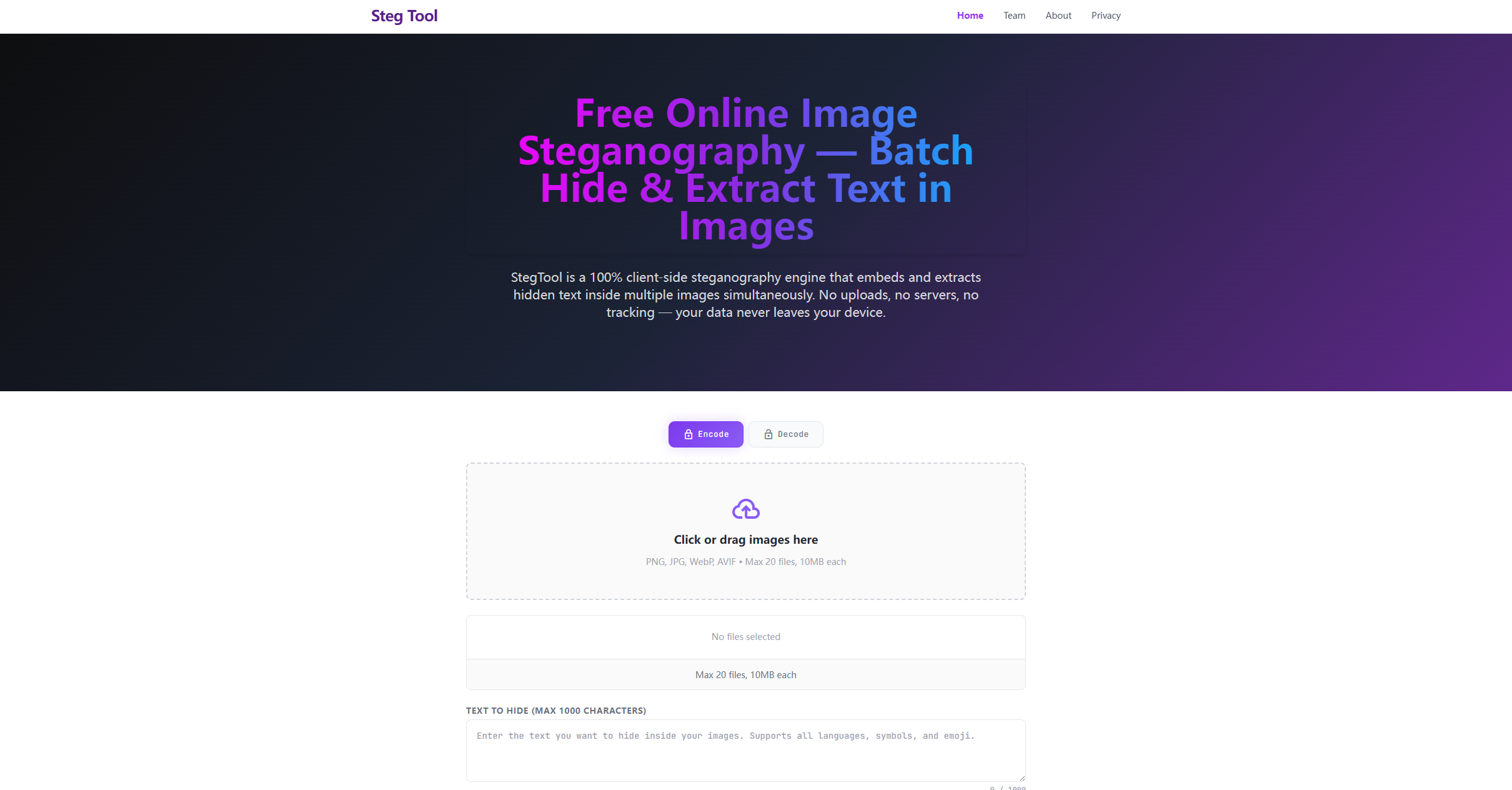
StegTool is not a traditional cloud application. It is a framework-free, zero-dependency JavaScript engine that executes entirely within your browser's sandboxed runtime. Every computational step — from file ingestion to pixel manipulation to final export — happens on your device, using only native browser APIs that have been standardized across all modern browsers since 2017.
The LSB Encoding and Decoding Pipeline
At the heart of StegTool lies the Least Significant Bit (LSB) algorithm — the most widely studied and deployed steganography technique in academic literature and industrial practice. The algorithm exploits a fundamental truth of digital color representation: every pixel in an RGB image is encoded as three 8-bit integers (Red, Green, Blue), each capable of representing 256 distinct intensity levels. The least significant bit — the rightmost binary digit — controls whether the channel value is even or odd. Flipping this bit changes the channel's luminance by exactly 1/256th of its total range, a delta that falls well below the just-noticeable difference threshold established by decades of psychophysical color perception research.
StegTool's encoding pipeline proceeds in four stages. First, the user's text input is converted to a UTF-8 binary stream using the browser's native TextEncoder API, which correctly handles all Unicode code points — including multi-byte sequences for CJK characters, Arabic script, and emoji. Second, the source image is rasterized onto an offscreen HTML5 Canvas, producing a raw, uncompressed RGBA pixel matrix regardless of whether the original file was PNG, JPG, WebP, or AVIF. Canvas image smoothing is explicitly disabled to prevent anti-aliasing interpolation that could corrupt adjacent pixel data during extraction. Third, the engine iterates through every pixel's R, G, and B channels (skipping the Alpha channel for cross-platform compatibility) and replaces each channel's LSB with the next bit from the binary stream. Fourth, a 16-bit zero delimiter — equivalent to two NUL bytes in UTF-8 — is appended to mark the exact end of the hidden payload.
The decoding pipeline reverses this process with equal precision. The extractor scans pixel channels in the same R-G-B order, collecting LSB values into a buffer. When 16 consecutive zero bits are detected — the delimiter sequence — extraction halts immediately. The bits collected before the delimiter are grouped into 8-bit bytes and decoded back into the original UTF-8 string via the TextDecoder API. This delimiter-based protocol means the decoder requires no prior knowledge of the message length, no separate metadata channel, and no out-of-band communication — the steganographic payload is entirely self-describing within the image data itself.
Privacy-First Design: Zero Server Architecture
StegTool's zero-server architecture is a deliberate engineering decision rooted in the recognition that steganography tools pose unique privacy risks when implemented as cloud services. A server-based steganography platform would necessarily receive both the carrier images and the hidden text from every user — creating a centralized repository of secrets that would be a high-value target for attackers, subpoenas, and insider threats. Even if the service provider promised to delete data after processing, users would have no technical means to verify this claim.
StegTool eliminates this trust requirement entirely by executing all computation on the client side. The FileReader API reads user-selected images into volatile JavaScript memory. The Canvas API provides pixel-level read/write access to the image data. Bitwise JavaScript operators perform the LSB substitutions with native CPU efficiency. Canvas.toBlob() serializes the modified pixel matrix back into a downloadable PNG file. At no point in this pipeline is any data transmitted over the network — no XMLHttpRequest, no Fetch API call, no WebSocket connection, no hidden iframe postMessage. Users can verify this independently by opening their browser's Developer Tools (F12 → Network tab) while using StegTool: the only network activity visible will be the initial static asset loads and Google Analytics page-view beacons, neither of which carry any file content or hidden text data. Disconnecting the internet after page load has zero impact on functionality — every feature remains fully operational offline.
Real-World Steganography Applications
Steganography is not merely an academic curiosity — it is a practical tool deployed across industries for copyright enforcement, secure communication, and digital asset management. StegTool's batch processing capabilities and zero-server architecture make it suitable for several critical real-world scenarios.
Digital Copyright and Asset Protection
Photographers, graphic designers, NFT artists, and stock media creators face a persistent challenge: their work is distributed across platforms that strip metadata, compress files, and separate images from their attribution context. A visible watermark protects against casual theft but degrades the viewing experience and can be cropped or inpainted away. EXIF and IPTC metadata — the standard containers for copyright information — are routinely stripped by social media platforms (Facebook, Instagram, X), messaging apps (WhatsApp, Telegram), and content delivery networks during image optimization. Steganographic watermarks embedded via LSB encoding survive all of these transformations because they reside in the actual pixel data — not in fragile metadata headers. A creator who encodes their copyright notice, license identifier, or blockchain ownership token into every image they publish retains a cryptographically verifiable proof of authorship that persists through any workflow that preserves lossless pixel integrity. When an unauthorized reproduction surfaces, the creator can decode the hidden payload and demonstrate original ownership — a forensic capability that visible watermarks and metadata alone cannot provide.
Batch Steganography for Enterprise Workflows
Enterprise content teams managing thousands of product images, marketing assets, or internal documents need steganography at scale — not one image at a time. StegTool's batch processing engine handles up to 20 images simultaneously, with each file capped at 10MB to ensure stable memory utilization even on standard office hardware. A single text payload — whether a department identifier, a document classification label, a version hash, or an access control token — is injected uniformly into every image in the batch. The sequential download pipeline delivers each encoded PNG directly to the user's download folder without intermediate ZIP packaging, enabling immediate integration into existing content management pipelines. This batch-first architecture distinguishes StegTool from single-image steganography tools and makes it viable for production deployment in media agencies, e-commerce platforms, and legal document processing environments where throughput matters.
Secure Covert Communication Channels
In environments where encrypted communication channels are blocked, monitored, or legally restricted, steganography provides an alternative vector for transmitting sensitive information. An image posted to a public forum, attached to an email, or uploaded to a cloud storage service can carry a hidden message that is indistinguishable from any other image. Because the carrier image appears completely normal — no garbled ciphertext, no unusual file signatures, no anomalous entropy patterns — it passes through automated content filters, deep packet inspection systems, and manual review without triggering alerts. The recipient, who knows to expect a steganographic payload and uses StegTool's decode panel (or any compatible LSB extractor), can recover the hidden text offline. Combined with pre-shared encryption keys — where the message is encrypted before LSB encoding — this creates a two-layer security model where an adversary must both detect the steganographic payload and break the encryption to access the plaintext. StegTool's zero-server architecture is particularly important in this context: the tool can be downloaded and run entirely offline, leaving no trace of its use on any remote server.
Contact

We are the 345tool Team
345tool is an independent developer collective engineering elite, pure client-side, and privacy-first web utilities to replace bloated internet tools.